The weather around Puyallup and the rest of the Puget Sound region has a way of reminding us how much we rely on our heating systems. When a furnace starts acting up during a chilly stretch, deciding what to do next is not always simple. Some folks hope a quick fix will stretch things through another season, while others worry that throwing money at old equipment is a waste.
We talk with homeowners every day who are stuck between repairing and replacing, and the truth is that every situation is a little different. Still, there are some patterns and warning signs that tend to repeat themselves, and knowing what to watch for can save you time, money, and a lot of frustration down the road.
How Old Is Your Furnace, Really?
Age is one of the first clues to figuring out whether a repair makes sense. Most furnaces in our area have a lifespan of 15 to 20 years, though we occasionally see systems hang on a little longer when they’ve been maintained consistently. Once a unit crosses the 15-year mark, problems tend to come faster, and repairs usually get more expensive.
Homeowners tell us all the time that their furnace “has been fine for years” until it suddenly wasn’t. That is usually how it goes. Internal parts wear slowly, airflow weakens, energy bills creep up, and then a major component fails at an inconvenient moment. When that happens on an older furnace, it is worth asking yourself how much more life you can expect to get from this system.
A few simple guidelines can help you gauge where you stand:
- Has your system required more than two repairs in the last year or two
- Are you keeping up with maintenance, or unsure of your service history
- Is the furnace older than the water heater you installed years ago
- Do you notice uneven heating or cold rooms that used to stay warm
- Are winter utility bills noticeably higher than they used to be
These signs tell us that a furnace is likely nearing the end of its useful life. You can still choose to repair it, but the return on that investment may not feel worthwhile for long.
Understanding the Real Cost of Furnace Repairs
Repair bills are not always predictable, and that can make decisions even more stressful. One homeowner may get lucky and only need a minor fix, while the next might be facing a multi-part repair that costs a few hundred dollars more than expected. We always look at the bigger picture with families we work with, because the repair cost of your furnace is only one piece of the puzzle.
Most of the time, furnace repair makes sense when a system is fairly young or the issue is isolated to one part. But as the furnace gets older, those repairs can start stacking up. Homeowners sometimes end up chasing one malfunction after another simply because the internal parts are all the same age. At that point, you might be spending your budget on temporary solutions.
Some of the most common repair cost factors include:
- The age of the furnace and the availability of parts
- Whether the failure is electrical, mechanical, or heat exchanger-related
- How long the furnace has been neglected or unmaintained
- The complexity of the repair and the required diagnostic time
- Whether additional unsafe conditions are discovered
- The price of specialized components for older furnaces
A good rule of thumb is this: if a repair approaches 30 percent of the cost of a replacement, you should at least compare your options. Sometimes the long-term savings of a newer, more efficient furnace outweigh the short-term savings of a repair.
When Specific Parts Fail: Sequencers, Pressure Switches, and Other Key Components
Certain parts of older furnaces are more likely to fail, including furnace sequences, the furnace pressure switch, and limit switches. These components help keep the system running safely and in the proper order, so when one stops working, the furnace may shut down or short-cycle. Repairs for these parts can be reasonable, but the question is whether the rest of the system is in good enough shape to justify the investment.
A sequencer failure, for example, usually signals that the unit is struggling to regulate heat output. Replacing the sequencer might solve the issue, but if the furnace is significantly older, this could be the first of several upcoming repairs. A malfunctioning pressure switch often points to airflow or venting issues, which may indicate larger internal wear.
Here are a few symptoms that often show up when these components are on their last legs:
- The furnace turns on, then shuts off again right away
- Heat output feels weaker than normal, or the furnace even blows cold air
- The blower seems to run nonstop
- You smell electrical or metallic odors around the furnace
- The furnace won’t start at all
- Repeated error codes appear on your thermostat or control board
These problems can sometimes be handled affordably, but they can also hint that more major repairs may not be far behind. That context matters when you’re deciding whether to repair or replace.
The Furnace Blower Motor: A Critical and Costly Component
The furnace blower motor is the part that pushes warm air throughout the home. When this component fails, the furnace can heat all day long but still leave your home cold because the air never moves through the ducts. Blower motor repairs vary widely in price depending on the type of motor, its speed settings, and whether your system uses an ECM motor or a more traditional design.
For older furnaces, replacing a blower motor often becomes one of the most expensive repairs. If your unit is well past its prime, you may end up spending more than you planned on a system that has limited life left. We often help homeowners compare the cost of the repair to the furnace replacement cost so they can see the long-term picture.
A struggling blower motor usually shows several early warning signs, such as:
- Whining or grinding noises
- Weak airflow from vents
- Hot or burning smell from the furnace cabinet
- The furnace overheating and shutting off
- Rising utility bills despite normal usage
When multiple symptoms appear, it is usually a sign that the problem is more than just a single worn part.
Control and Safety Issues: Circuit Boards and Electrical Failures
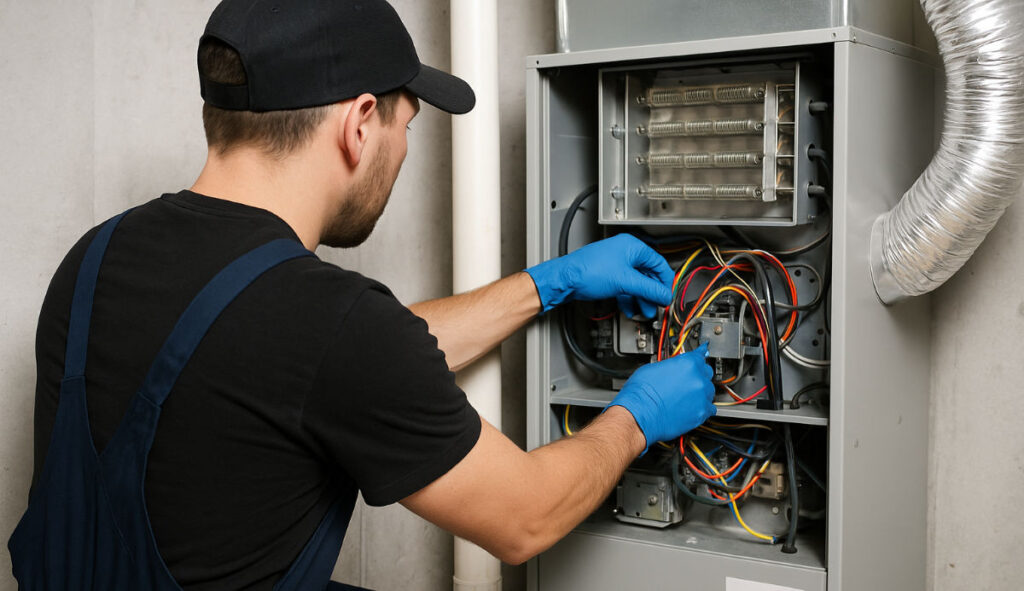
A furnace circuit board handles the sequencing, timing, and electrical commands that tell the whole system when to start, stop, and adjust output. When the board fails, you might see random shutdowns, intermittent heating, or the blower running at odd times. The repair cost depends heavily on whether the board is still available, because older model boards can be harder to source.
Electrical failures tend to be frustrating for homeowners because they often appear out of nowhere. You might wake up to a cold house even though everything worked perfectly the night before. If your furnace is older, replacing the circuit board could give you a little more time, but many homeowners decide to put that money toward a new furnace installation instead.
Electrical failures sometimes signal broader system issues, such as:
- Voltage irregularities
- Worn wiring harnesses
- Loose connections from vibration
- Repeated overheating cycles
- Failed safety switches
If more than one electrical issue is happening on an aging system, replacement typically becomes the more cost-effective route.
When the Heat Exchanger or Major Components Fail
Some repairs are simply not worth pursuing, especially when major components like the heat exchanger show signs of failure. A cracked heat exchanger is a serious safety risk because it can allow combustion fumes to enter the home. Most of the time, replacing the heat exchanger costs close to a full furnace replacement. This is one of those cases where upgrading is almost always the safest and smartest choice.
Similarly, if your furnace has a combination of airflow problems, repeated overheating, and rising repair costs, it may be giving you every sign that its best days are behind it. We meet families all the time who have spent good money on repairs in the past, only to wish later that they had upgraded sooner. Newer furnaces are far more efficient, quieter, and better for long-term comfort in our Puyallup climate.
When we evaluate older systems, we look for patterns such as:
- Multiple major failures within a short time
- Soot or discoloration near the furnace cabinet
- Unsafe operating conditions
- Chronic airflow restrictions
- Excessive energy usage
These signals usually mean the furnace is no longer operating as it should, and replacement becomes the better long-term investment.
What to Expect from the Cost of a Full Furnace Replacement
Many homeowners hesitate to even consider replacement because they assume it will be unaffordable. The truth is that furnace replacement cost can vary widely depending on the size of the home, furnace efficiency level, local utility incentives, and indoor air quality options. Not every family needs the highest-end system to feel comfortable. Often, a mid-tier furnace provides excellent reliability and efficiency at a very reasonable price point.
While we always provide free, no-pressure estimates, it helps to understand what goes into a replacement quote. Factors that affect pricing include furnace size, ductwork condition, electrical requirements, venting updates, and additional comfort features. When you combine those details with available rebates and financing options, many homeowners find that new equipment fits into their budget more easily than expected.
A new furnace installation is not just about replacing an old appliance; it is an opportunity to improve comfort, reduce energy bills, and prevent future breakdowns. That peace of mind goes a long way when winter rolls in across the Puget Sound.
Look No Further Than Taylor for Furnace Repair and Replacement in Puyallup, WA
If you are unsure whether your furnace is worth repairing or if it is time to plan for an upgrade, we are here to help. Our team brings decades of hands-on experience, along with reliable diagnostics and honest recommendations. Families across Puyallup rely on our heating services because they know they will get clear answers and dependable solutions.
As longtime Puyallup HVAC experts, we take pride in helping homeowners stay warm, safe, and comfortable every winter. Whether you need a quick furnace repair or you want to explore furnace replacement options, our technicians handle everything with care and craftsmanship. When you call Taylor Heating, Cooling, Plumbing & Electrical, you become part of the family, and your comfort becomes our priority.